

wire 2026 trade fair
Why Your Shop Floor Knows More Than Your ERP
From hidden knowledge to measurable performance!
Vom 13. bis 17. April 2026 zeigen wir Ihnen an unserem Stand auf der wire 2026 (Halle 16, Stand 16H27) wie Sie Ihre Shopfloor-Kennzahlen zur wertvollsten Ressource Ihrer Produktion machen.
From April 13 to 17, 2026, we will show you at our booth at the wire 2026 trade fair (Hall 16, Booth 16H27) how you can turn your shop floor key performance indicators into your most valuable production resource.
Ready for a knowledge advantage?
In the weeks leading up to wire 2026 trade fair, we will keep you informed with a series of accompanying articles. Week by week, we will show you how you can make your production more efficient and productive with the support of your shop floor key figures. We kick off today with the crucial difference between controlling and process control. The remaining chapters will follow in the coming weeks as exclusive blog posts.
Your shop floor knows more than you think.
It’s time to put that knowledge to work.
Your shop floor knows more than you think. It’s time to put that knowledge to work.
Most companies react instead of acting. When problems arise in production, they resort to “firefighting.” This results in a loss of time, money, and, often more importantly, process stability. Yet the answers are usually right in front of them:
in the shop floor data.
When the ERP is still calculating while real time is already setting the pace in the hall
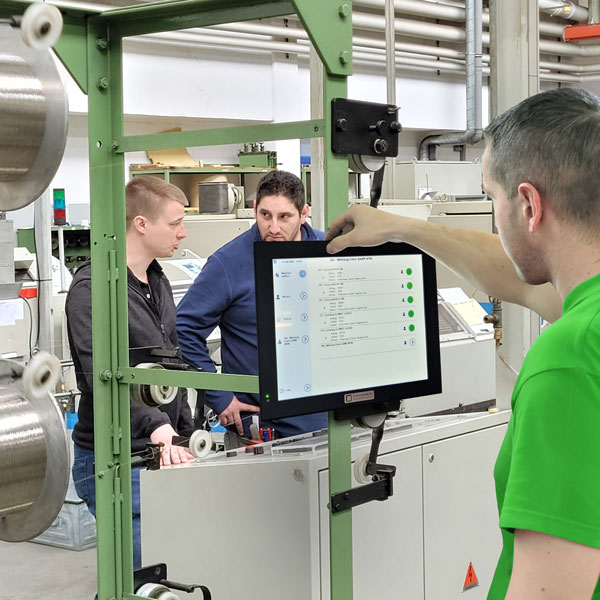
Management and shop floor speak different “key figure languages.” While monthly, aggregated reports from the ERP system are considered gospel in the office, real time is what matters on the shop floor. When management determines that OEE was too low in the previous month, this is purely a performance review, not active control. The causes of downtime or quality losses have long since disappeared into the noise of the past.
Without a digital bridge, decisions remain dependent on individuals, and measures are almost always too late.
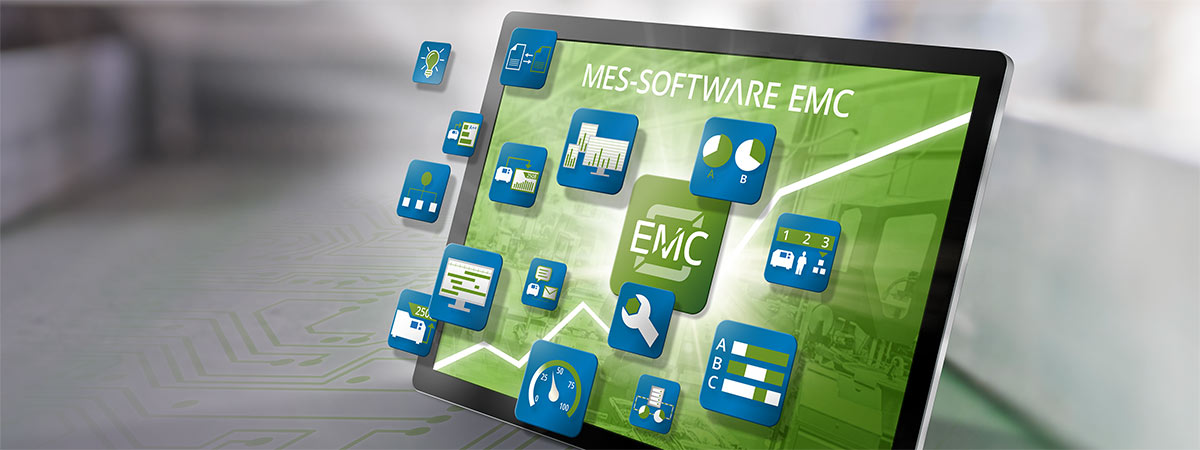
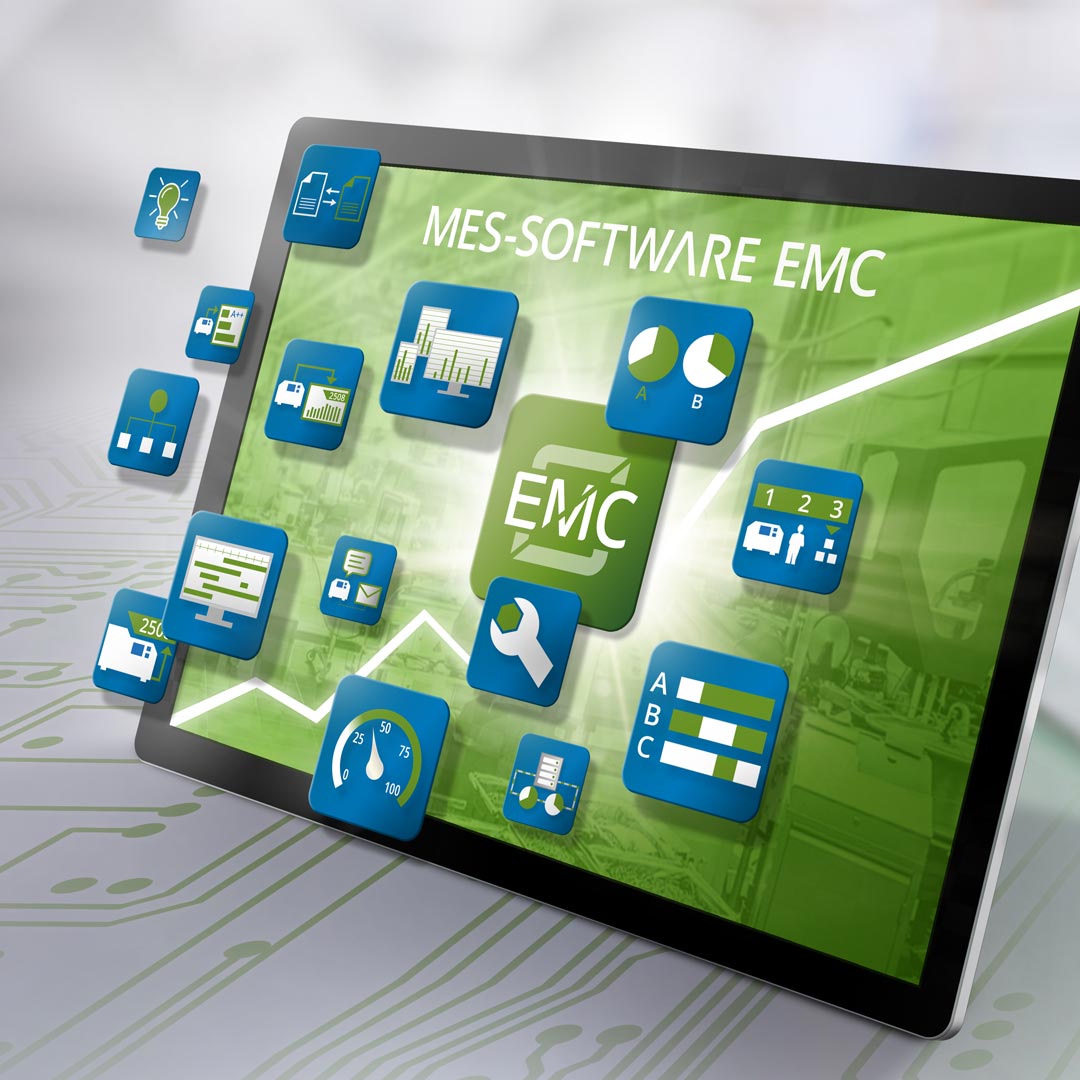
We close this gap with the MES Software EMC.
Key performance indicators are not a control mechanism, but rather our shared navigation system for proactive process design.
But how does that differ from what
you’ve been doing so far?
you’ve been doing so far?
But how does that differ from what you’ve been doing so far?
One data set, two truths
One of the primary objectives of the MES Software EMC is the synchronization of the shop floor and management. The underlying data and key figures are the same, but trigger different responses.
Truth 1 (shop floor):
“Machine 4 has been down for 10 minutes due to a broken tool. We have to act NOW, otherwise we’ll miss the delivery deadline.”
Truth 2 (Management):
“Downtime due to tool breakage has fallen by 15% this month. Our investment in the new tooling system is paying off.”
Controlling tells you whether you won or lost last month. Process control on the shop floor ensures that you win today.
If your shop floor “knows more” than your ERP,
it’s because it thinks in terms of production cycles,
while the ERP sets the pace
for the entire organization.
it’s because it thinks in terms of production cycles,
while the ERP sets the pace
for the entire organization.
If your shop floor “knows more” than your ERP, it’s because it thinks in terms of production cycles, while the ERP sets the pace for the entire organization.
Forward-looking headlights for team leaders
Leaders need foresight, not rearview mirrors. Key performance indicators turn mere numbers into an early warning system. This allows team leaders to immediately see where the shift stands or when an order is complete. And they can take immediate countermeasures before bottlenecks arise.
The fundamental question in process control is therefore always:
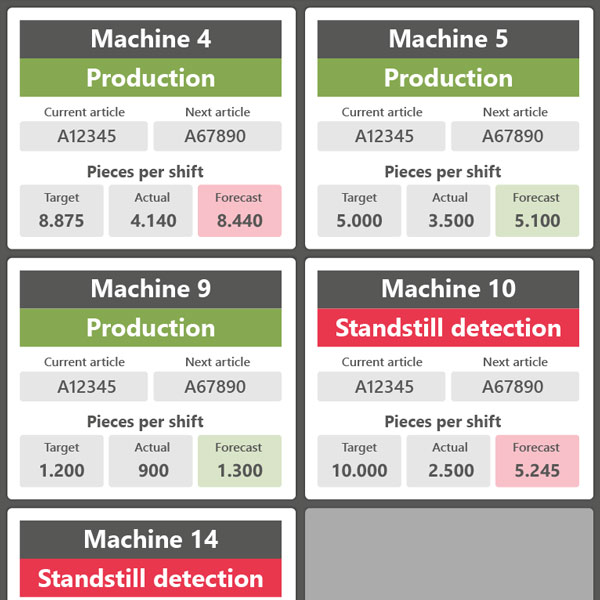
Example 1:
Achievement of shift targets
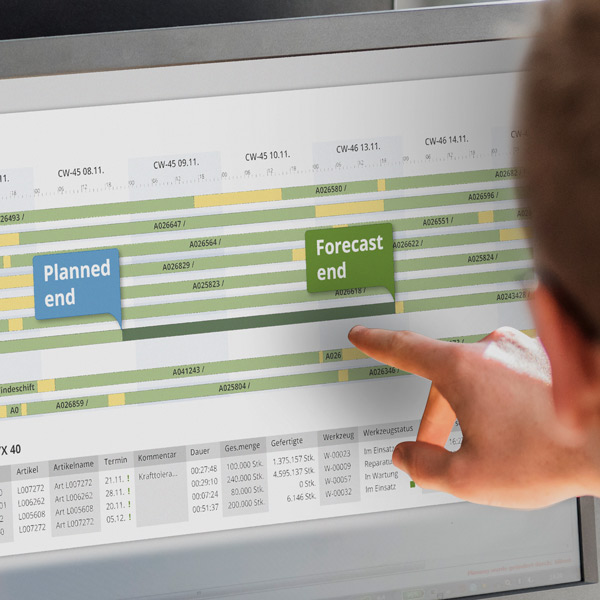
Example 2:
Planning with plan end and forecast
What do we need to do NOW to ensure that the process works
and the quality is right?
and the quality is right?
What do we need to do NOW to ensure that the process works and the quality is right?
Controlling and process control are two sides of the same coin: while controlling provides us with the necessary transparency regarding the results achieved, process control enables us to act in real time. This means we use ERP data not only for documentation purposes, but also to ensure success right from the outset.
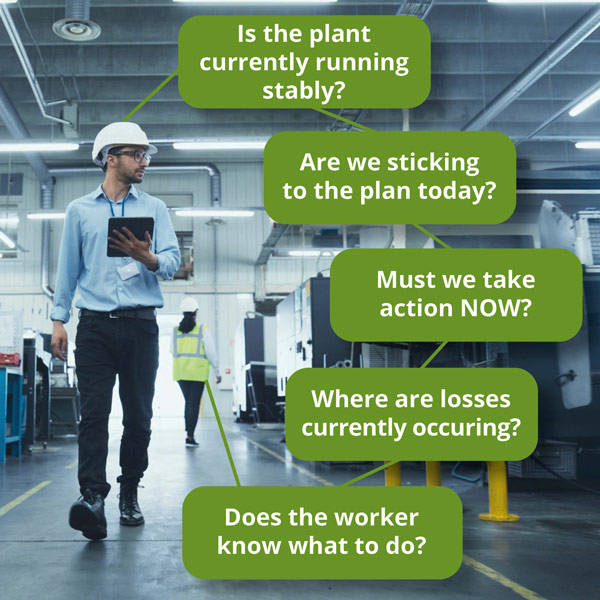
The ERP system knows that an order is running late. Process control knows why it is losing time right now and how to prevent this. Agile process control means actively managing production: operationally, at the moment it happens.
The Questions of Truth
Every successful shift supervisor constantly asks themselves the same questions. However, the answers to these questions cannot be found in yesterday’s reports. They can be found in the live data generated directly at the machine. In an analog shop floor, the answer is often a “gut feeling.” In a digitalized shop floor with the MES Software EMC, it is based on facts.
Find answers quickly
In digitally networked manufacturing, answering the above questions is child’s play. The modules of the MES Software EMC provide the answers. All data collected on the shop floor is continuously processed and used for specific purposes.

Is the plant currently running stably?
EMC Control: Perform and document production checks reliably using automated control messages on the terminal.
Are we sticking to the plan today?
EMC Detailed Planning: Resource-optimized detailed planning based on the calculated data from the ERP and the actual progress of the machines.
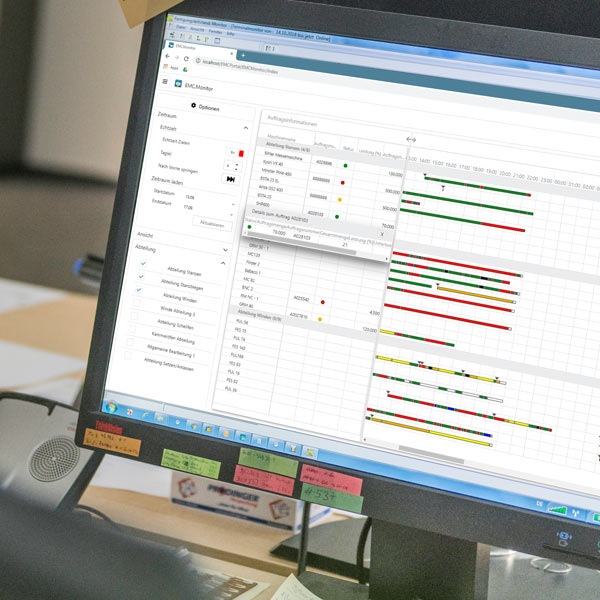
Must we take action NOW?
EMC Monitoring: An up-to-date view of production by combining data from machines, orders, and employees.
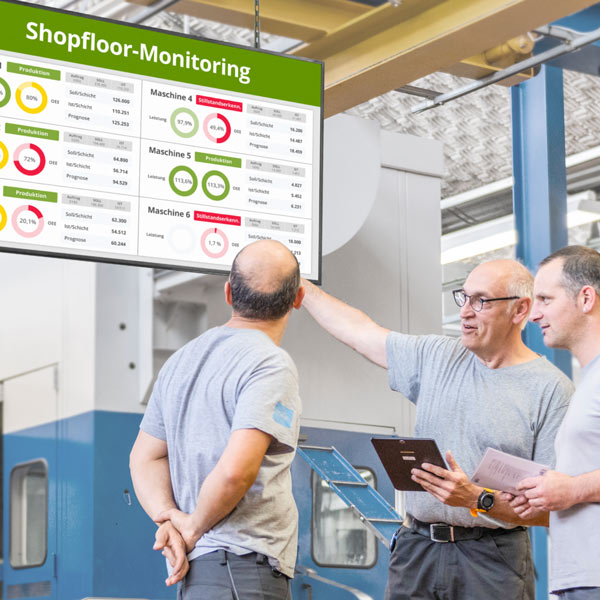
Where are losses currently occurring?
EMC Dashboard: Current production status visualized directly on the shop floor via individually configurable dashboards.
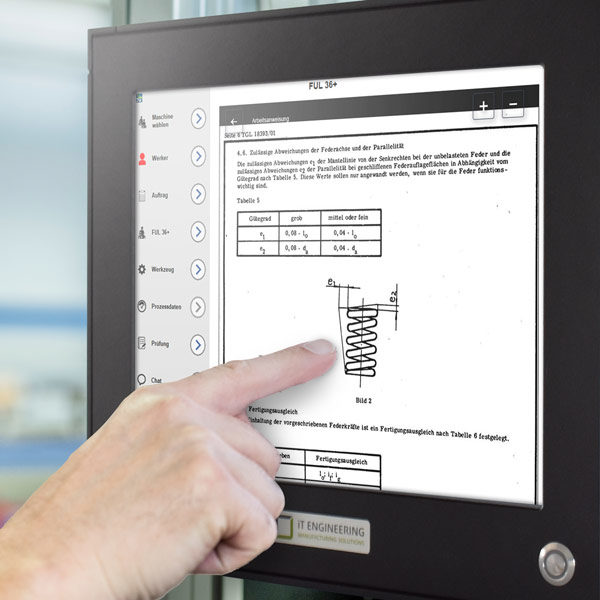
Does the worker know what to do?
EMC KnowledgeBase: Consolidate important information and make it available where it is needed, without paper.
Is the plant currently running stably?
EMC Control: Perform and document production checks reliably using automated control messages on the terminal.
Are we sticking to the plan today?
EMC Detailed Planning: Resource-optimized detailed planning based on the calculated data from the ERP and the actual progress of the machines.
Must we take action NOW?
EMC Monitoring: An up-to-date view of production by combining data from machines, orders, and employees.
Where are losses currently occurring?
EMC Dashboard: Current production status visualized directly on the shop floor via individually configurable dashboards.
Does the worker know what to do?
EMC KnowledgeBase: Consolidate important information and make it available where it is needed, without paper.
Controlling as compass
While process control operates in the “here and now,” controlling takes a bird’s-eye view of the company. It is not concerned with individual machine stoppages, but with the big picture: profitability.
The goal is to ensure that corporate objectives are met by using aggregated, periodic data (monthly/quarterly). Production is evaluated here: strategically, retrospectively, and in terms of planning.
The overarching mindset in controlling is always:
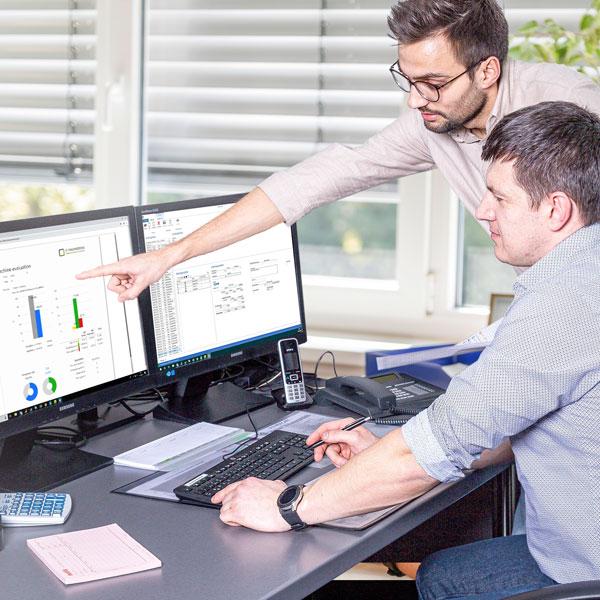
Are we doing the right things overall
and achieving our goals?
and achieving our goals?
Are we doing the right things overall and achieving our goals?
You have seen how different the languages of controlling and process control are. Managing by key performance indicators is not like looking in the rearview mirror, but rather like using a real-time navigation system directly at your workplace. For key performance indicators to be effective, they must speak a language that workers on site can understand immediately. And even more importantly, they must be able to actively influence them.
- From knowledge to action: Key performance indicators are not statistics, but impulses. If the “route” deviates, clear standards enable immediate countermeasures.
- Tangible key figures: Whether it’s good parts per hour, cycle time compliance, target/actual comparison, or current downtime, these key performance indicators are the guard rails for a proactive shift.
- Controlling the levers: We don’t just focus on the end result, we actively control the influencing factors. For progress that can be shaped the moment it arises.
Discover all episodes of the info series now
This is exactly where we come in. Over the coming weeks, we will be publishing a series of blog articles showing you how agile management works with shop floor key performance indicators. After all, we are at a turning point in the manufacturing industry. The question today is no longer whether production will be digitized, but how quickly it can translate the insights gained into market advantages.
An ERP system is an important backbone, but it is not the engine. The real engine is your shop floor. When you start to understand the language of your machines and translate it into real-time actions, you are not just changing numbers. You are changing your entire corporate culture.
You can find out exactly how in the following articles:
If your shop floor “knows more” than your ERP, it’s because it not only collects data,
but also immediately weights it according to relevance and makes it visible.
but also immediately weights it according to relevance and makes it visible.
If your shop floor “knows more” than your ERP, it’s because your employees have
the tools to turn that knowledge into real value creation.
the tools to turn that knowledge into real value creation.
If your shop floor “knows more” than your ERP, it’s because it gets its data directly from the source: in real time and without the filter of human fallibility.
If your shop floor “knows more” than your ERP, it’s because it not only collects data, but also immediately weights it according to relevance and makes it visible.
If your shop floor “knows more” than your ERP, it’s because your employees have the tools to turn that knowledge into real value creation.
If your shop floor “knows more” than your ERP, it’s because it gets its data directly from the source: in real time and without the filter of human fallibility.
We now know why key performance indicators are the key to agile management. But a key performance indicator is only as strong as the software that calculates it. With the MES Software EMC, you are not choosing an isolated tool, but the heart of your digital factory.
A system for the entire value chain
The innovative MES Software EMC from iT Engineering Manufacturing Solutions GmbH has many other options for cleverly digitalizing your production and thus optimizing numerous processes. Whether holistically or step-by-step, EMC enables the digital control of processes on the shopfloor. And individually tailored to your production and your needs.
Benefit from continuous further development, including regular updates during operation. As a strong partner for digitalization, we are always at your side and support you with professional advice, ongoing support, training and coaching for your employees and much more.
Get started digitally now!